- Aim for at least 150 minutes of moderate activity, 75 minutes of vigorous activity, or a blend each week.
- The 150-minute recommendation is an encouraging target, not a pass/fail mark—even a 10-minute walk brings tangible health gains.
- Adults need muscle-strengthening activities on at least 2 days a week covering all major muscle groups.
- Refreshed guidance includes advice for people on GLP-1 weight-loss medications to do resistance training to combat muscle loss.
The 2026 Update in a Nutshell
"How much exercise should I be doing?" sounds like a simple question, yet ask five people and you'll get five different answers. The good news is that the UK has an official answer, it was refreshed this summer, and it's more forgiving than you might think.
In July 2026 the four UK Chief Medical Officers updated their physical activity guidance. The headline numbers haven't changed, but there's a new focus on how small amounts of movement, like taking the stairs or walking to the shops, add up to real physical and mental health benefits.
For adults aged 19 to 64, the core recommendations are:
- Be physically active every day, because some activity is always better than none.
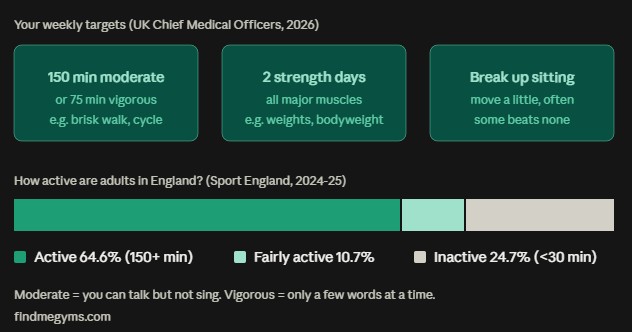
- Aim for at least 150 minutes of moderate activity a week, or 75 minutes of vigorous activity, or an equivalent mix.
- Do muscle-strengthening activities on at least two days a week.
- The NHS emphasizes that strength work should hit all major muscle groups (legs, hips, back, abdomen, chest, shoulders, and arms).
150 Minutes Is a Target, Not a Pass Mark
This is the part of the update worth shouting about: the biggest health gains come from moving from doing nothing to doing anything. The guidance says the 150 minutes shouldn't be treated as an absolute threshold.
Activity doesn't need to happen in long or structured sessions either. Dancing, gardening, active play, brisk walking and household tasks all count towards your total.
The CMOs put it plainly: even small amounts of activity bring important benefits compared with none, and those benefits keep rising up to the 150-minute mark. If you're starting from zero, a ten-minute walk after lunch is a genuine win, not a failure to hit the target.
Moderate Versus Vigorous: The Talk Test
You don't need an expensive smartwatch or heart rate monitor to know which zone you're in. You can simply use the practical "talk test":
Moderate activity raises your breathing rate and heart rate, but you can still comfortably hold a conversation, though you'd struggle to sing. Brisk walking, casual cycling, and water aerobics sit here.
Vigorous activity leaves you able to say only a few words before needing to catch a breath. Think running, spin classes, high-intensity intervals, or fast swimming. Because vigorous work is more demanding, 75 minutes of it achieves roughly the same cardiovascular benefits as 150 minutes of moderate activity.
The Bit Most People Skip: Strength Training
Plenty of people tick off their cardio and completely forget the rest. The NHS is clear that muscle-strengthening exercises aren't always aerobic, so you need to do them on top of your 150 minutes. That can mean free weights, resistance machines, bodyweight moves like squats and press-ups, or even heavy gardening.
The refreshed guidance also carries a timely warning for people on GLP-1 weight-loss medications to prioritize resistance training to protect against lean muscle mass loss. Furthermore, it stresses strength and balance work to prevent frailty as we age.
For adults over 65, the advice is the same weekly volume as younger adults, plus specific activities for strength, balance, and flexibility on at least two days a week.

Prolonged Sitting Is Its Own Problem
Hitting your gym targets doesn't fully cancel out spending eight hours chained to a desk without moving. The guidance notes that prolonged sedentary time is harmful even in people who meet the moderate activity targets.
Stand up during phone calls, take the stairs, walk over to chat with a colleague rather than messaging, and stretch every 60 minutes. Little and often really does make a biological difference.
How Does the UK Measure Up?
Better than you might expect. Sport England's latest survey found that 64.6% of adults (30.9 million people) averaged 150 minutes or more a week, while 24.7% (11.8 million) managed less than 30 minutes. There is still a gender gap, with 67% of men active compared with 62% of women.
What a Realistic Week Looks Like
You don't need to train like an Olympic athlete. Here is one simple weekly template that hits every UK guideline with time to spare:
- Monday: 30-minute brisk walk during lunch
- Tuesday: 40-minute full-body strength workout at the gym
- Wednesday: 30-minute bike ride or swim
- Thursday: Rest day, or a gentle stroll
- Friday: 40-minute gym resistance session
- Saturday: 45-minute outdoor walk, park run, or active sport
- Sunday: Complete rest and recovery
Where a Gym Fits In
You can meet the guidelines without ever joining a gym, but a gym makes the strength side much easier and more consistent. You get access to weights, machines that guide your form safely, classes that structure your workouts, and trained staff who can demonstrate proper technique.
If you have an underlying health condition, are pregnant, or haven't exercised in a long time, consult with your GP before starting a rigorous new routine.
Find a Gym Equipped for Your Weekly Routine
Search gyms with dedicated lap swimming pools, sauna thermal suites, and full resistance areas.