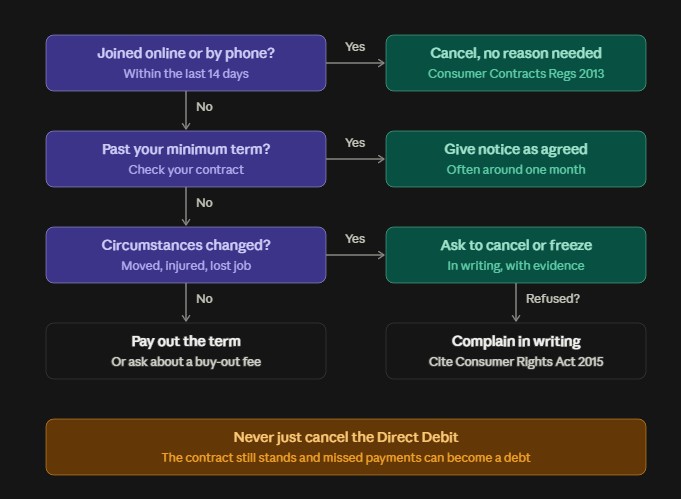
- Online sign-ups are protected by a 14-day statutory cooling-off period under the Consumer Contracts Regulations 2013.
- Never cancel your Direct Debit before formally ending your membership; doing so creates debt arrears and collection agency fees.
- Under the Consumer Rights Act 2015 and the OFT v Ashbourne Management (2011) High Court ruling, contract terms locking you in unfairly can be challenged.
- Major subscription reforms under the Digital Markets, Competition and Consumers Act 2024 will introduce mandatory one-click cancellations by Spring 2027.
First, the Honest Bit: There's No Gym Ombudsman
You've moved house, lost your job, picked up an injury, or simply stopped going. Now you want out of your gym contract, and the gym isn't making it easy. Here's what UK consumer law actually says, and how to handle it without ending up in debt.
Unlike energy, telecommunications, or banking, there is no official industry ombudsman or dedicated sector watchdog for gyms in the UK. What protects you instead is general consumer law, one landmark High Court case, and whatever your gym's own contract terms grant. That makes it essential to know where you stand before you pick up the phone.
Your 14-Day Cooling-Off Period (Online Sign-ups)
If you joined online, by phone, or away from the gym's physical premises, the Consumer Contracts Regulations 2013 give you a statutory 14-day cancellation window without giving any reason.
If you used the gym during those 14 days, the club is entitled to deduct a fair, proportionate amount for your actual usage and refund the remainder of your fees.
There is a catch: if you signed up in person at the gym sales desk, this statutory cooling-off period does not automatically apply under UK law. Some gyms provide one anyway as a goodwill policy, so check your signed terms.
Minimum Terms and Notice Periods
Most fixed contracts include a minimum commitment period, typically 12 months, plus a notice requirement such as 30 days once that period is over.
Once you are past your minimum term, cancelling is usually straightforward: give notice in the format required by your contract (typically via member portal or email) and you are done. The trouble arises when you want to leave during the minimum term.
When Contract Terms Are Legally Unfair
The Consumer Rights Act 2015 allows courts to strike down unfair contract terms. Its indicative list includes disproportionately high cancellation charges and contracts the gym can terminate easily while you cannot.
Then there is OFT v Ashbourne Management Services Ltd (2011). In this landmark ruling, the High Court found gym contracts with 12 to 36-month minimum terms and zero exit provisions for changed circumstances to be legally unfair and unenforceable. If you are trapped in a long agreement with no exit clause, that is the legal precedent to cite.
What If Your Circumstances Have Changed?
It is a common misconception that there is an automatic legal right to cancel just because your circumstances changed. Beyond good commercial practice, it comes down to what your specific contract permits.
That said, many reputable gym operators do allow early exit or a temporary freeze for qualifying events like residential relocation (typically 10-15 miles away), serious injury, pregnancy, or documented job loss. It is always worth requesting in writing with supporting evidence.
A membership freeze is often a practical compromise. For instance, Chelmsford's council leisure centres allow freezes of up to three months at a time for a modest £5 monthly fee during initial commitment terms.
The Expensive Mistake: Cancelling Your Direct Debit
It is tempting to simply log into your banking app and stop the Direct Debit mandate. Do not do this. Cancelling the payment before formally terminating the membership is the classic error that turns a contract dispute into a credit debt.
Your contract remains legally active, the gym's billing system flags missed payments, administration penalty fees are applied (often £15-£25 per failed cycle), and the account may be referred to third-party collection agencies. Always cancel the membership first, obtain written confirmation of your final payment date, and only cancel the Direct Debit once that final payment has cleared.
A Step-by-Step Way to Cancel
Follow this structured procedure to protect your credit record:
- Find your original contract: Check the minimum term, notice period, and clauses covering relocation, illness, or hardship.
- Put your request in writing: Email or submit via the gym's tracked member portal. Include your membership number and desired cancellation date.
- Provide evidence if relevant: A medical practitioner's note, new tenancy agreement, or redundancy notice significantly strengthens an early termination request.
- Require written confirmation: Never assume the membership is closed until you receive written verification showing your final billing date.
- Escalate if necessary: If the gym refuses a fair request, contact Citizens Advice for free guidance. Small claims disputes up to £10,000 can be lodged via Money Claim Online in England & Wales.

What's Changing: The 2027 Subscription Reform
Cancelling subscriptions is set to become much easier. The Digital Markets, Competition and Consumers Act 2024 introduces a strict new regime for subscription contracts, which the UK Government expects to come into force in Spring 2027.
Once enacted, gym operators and subscription services must provide clear pre-contract information, send reminder alerts before auto-renewals, offer straightforward digital exit routes ("one-click cancellations"), and provide structured cooling-off refunds.
Government estimates suggest subscription traps cost UK consumers over £1.6 billion annually. Until the new regime begins, know your contract terms before you sign.
Looking for Flexible, No-Contract Gyms?
Avoid 12-month lock-in commitments. Compare rolling monthly memberships with zero cancellation penalties.